


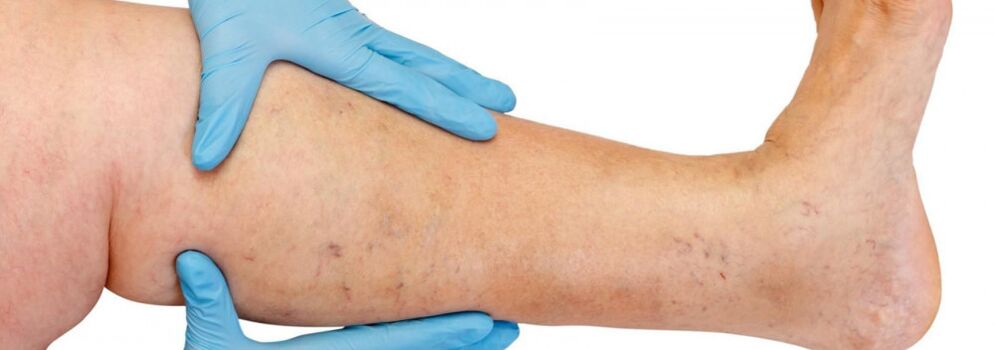
The anatomical structure of the venous system of the lower extremities is characterized by great variability.Knowledge of the individual characteristics of the structure of the venous system plays a large role in the evaluation of the data from the instrumental examination and in the selection of the correct method of treatment.
The veins of the lower extremities are divided into superficial and deep.The superficial venous system of the lower extremities begins from the venous plexuses of the toes, forming the venous network of the dorsum of the foot and the cutaneous dorsal arch of the foot.From it originate the medial and lateral marginal veins, which pass into the great and small saphenous vein, respectively.The great saphenous vein is the longest vein in the body, contains 5 to 10 pairs of valves, and its normal diameter is 3-5 mm.It originates in the lower third of the leg in front of the medial epicondyle and ascends in the subcutaneous tissue of the leg and thigh.In the groin area, the great saphenous vein flows into the femoral vein.Sometimes the great saphenous vein of the thigh and leg can be represented by two or even three trunks.The small saphenous vein begins in the lower third of the leg on its lateral surface.In 25% of cases, it flows into the popliteal vein in the area of the popliteal fossa.In other cases, the lesser saphenous vein may rise above the popliteal fossa and drain into the femoral vein, the great saphenous vein, or the deep vein of the thigh.
The deep veins of the dorsum of the foot originate from the dorsal metatarsal veins of the foot, which drain into the dorsal venous arch of the foot, from where blood flows into the anterior tibial veins.At the level of the upper third of the leg, the anterior and posterior tibial veins merge, forming the popliteal vein, which is located laterally and slightly behind the artery of the same name.In the region of the popliteal fossa, the small saphenous vein and the veins of the knee joint flow into the popliteal vein.The deep vein of the thigh usually empties into the femoral vein 6-8 cm below the inguinal fold.Above the inguinal ligament, this vessel receives the epigastric vein, the deep vein surrounding the ilium, and passes into the external iliac vein, which merges with the internal iliac vein at the sacroiliac joint.The paired common iliac vein begins after the confluence of the external and internal iliac veins.The right and left common iliac veins merge to form the inferior vena cava.It is a large valveless vessel 19-20 cm long and 0.2-0.4 cm in diameter. The inferior vena cava has parietal and visceral branches through which blood flows from the lower limbs, lower torso, abdominal organs and pelvis.
Perforating (communicating) veins connect the deep veins with the superficial ones.Most of them have valves located suprafascially and thanks to which the blood moves from the superficial veins to the deep ones.There are direct and indirect perforating veins.Direct ones directly connect the deep and superficial venous networks, indirect ones connect indirectly, i.e.they first flow into the muscular vein, which then flows into the deep vein.
The majority of perforating veins arise from the tributaries rather than the trunk of the great saphenous vein.In 90% of patients there is incompetence of the perforating veins on the medial surface of the lower third of the leg.In the lower leg, incompetence of the perforating veins of Cockett, which connect the posterior branch of the great saphenous vein (vein of Leonardo) with the deep veins, is most often observed.In the middle and lower third of the thigh, there are usually 2-4 most permanent perforating veins (Dodd, Gunter), directly connecting the trunk of the great saphenous vein with the femoral vein.In varicose transformation of the small saphenous vein, incompetent communicating veins of the middle, lower third of the leg and in the area of the lateral malleolus are most often observed.
Clinical course of the disease
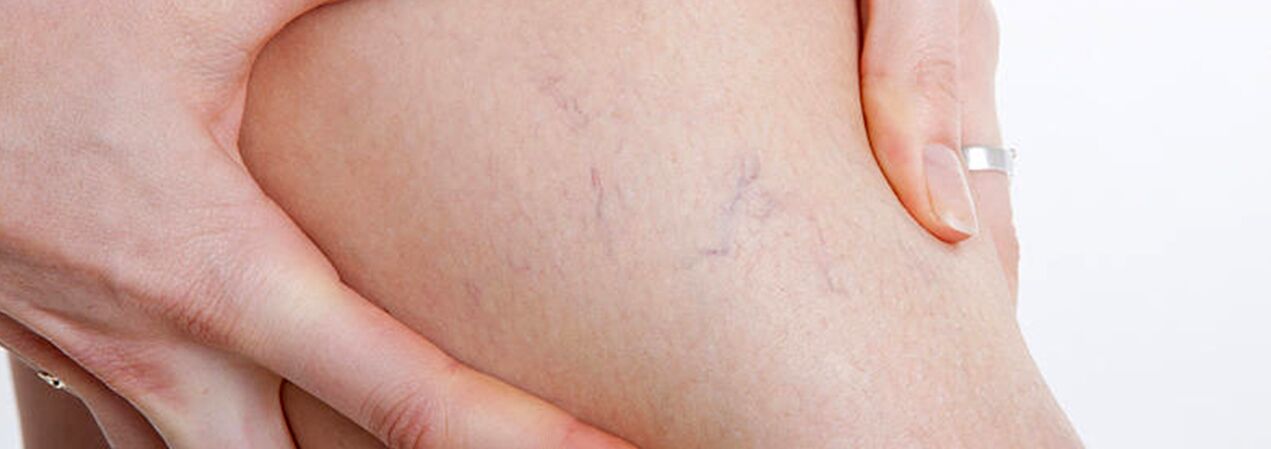
Varicose veins most often appear in the system of the great saphenous vein, less often in the system of the small saphenous vein and start from the tributaries of the leg vein trunk.The natural course of the disease in the initial stage is quite favorable;in the first 10 years or more, apart from a cosmetic defect, patients may have nothing to worry about.Subsequently, if timely treatment is not carried out, complaints of a feeling of heaviness, fatigue in the legs and their swelling after physical exertion (prolonged walking, standing) or in the afternoon, especially in the hot season, begin to appear.Most patients complain of pain in the legs, but with a detailed questioning it is possible to find that it is exactly a feeling of fullness, heaviness and fullness in the legs.Even with a short rest and an elevated position of the limb, the severity of the sensations decreases.It is these symptoms that characterize venous insufficiency at this stage of the disease.If we talk about pain, it is necessary to exclude other causes (arterial insufficiency of the lower extremities, acute venous thrombosis, joint pain, etc.).The subsequent progression of the disease, in addition to the increase in the number and size of varicose veins, leads to the appearance of trophic disorders, often due to the addition of incompetent perforating veins and the appearance of valvular insufficiency of the deep veins.
In case of insufficiency of perforating veins, trophic disorders are limited to any surface of the leg (lateral, medial, posterior).Trophic disorders in the initial stage are manifested by local hyperpigmentation of the skin, after which thickening (induration) of the subcutaneous fat tissue occurs until the development of cellulite.This process ends with the formation of an ulcer-necrotic defect that can reach a diameter of 10 cm or more and extend deep into the fascia.The typical site of venous trophic ulcers is the area of the medial malleolus, but the localization of lower leg ulcers can be different and multiple.At the stage of trophic disorders, severe itching and burning occurs in the affected area;Some patients develop microbial eczema.Pain in the area of the ulcer may not be pronounced, although in some cases it is intense.At this stage of the disease, the heaviness and swelling of the leg become constant.
Diagnosis of varicose veins
It is especially difficult to diagnose the preclinical stage of varicose veins, since such a patient may not have varicose veins on the legs.
In such patients, the diagnosis of varicose veins of the legs is mistakenly rejected, although there are symptoms of varicose veins, indications that the patient has relatives suffering from this disease (hereditary predisposition) and ultrasound data on initial pathological changes in the venous system.
All this can lead to missing deadlines for the optimal start of treatment, the formation of irreversible changes in the venous wall and the development of very serious and dangerous complications of varicose veins.Only when the disease is recognized at an early preclinical stage, it becomes possible to prevent pathological changes in the venous system of the legs through minimal therapeutic effects on varicose veins.
Avoiding various types of diagnostic errors and making a correct diagnosis is possible only after a thorough examination of the patient by an experienced specialist, a correct interpretation of all his complaints, a detailed analysis of the history of the disease and the maximum possible information about the condition of the venous system of the legs, obtained using the most modern equipment (instrumental diagnostic methods).
Sometimes a duplex scan is performed to determine the exact location of the perforating veins, identifying venovenous reflux in a color code.In the case of valvular insufficiency, their valves stop closing completely during the Valsava maneuver or compression tests.Valve insufficiency leads to the appearance of venovenous reflux, high through the incompetent saphenofemoral junction and low through the incompetent perforating veins of the leg.Using this method, it is possible to record the backflow of blood through the prolapsing leaflets of an incompetent valve.That is why the diagnosis is multi-stage or multi-level.In a normal situation, the diagnosis is made after ultrasound diagnosis and examination by a phlebologist.But in particularly difficult cases, the research should be carried out in stages.
- First, a thorough examination and questioning by a phlebologist surgeon is performed;
- if necessary, the patient is sent for additional instrumental research methods (duplex angioscanning, phleboscintigraphy, lymphoscintigraphy);
- patients with concomitant diseases (osteochondrosis, varicose eczema, lymphovenous insufficiency) are offered consultations with leading specialists-consultants on these diseases) or additional research methods;
- all patients requiring surgery are first consulted by the operating surgeon and, if necessary, by an anesthetist.
Treatment
Conservative treatment is indicated mainly for patients who have contraindications for surgical treatment: due to their general condition, with a slight expansion of the veins causing only cosmetic discomfort, or when surgical intervention is refused.Conservative treatment is aimed at preventing the further development of the disease.In these cases, patients should be advised to bandage the affected surface with an elastic bandage or wear elastic stockings, periodically put their legs in a horizontal position and perform special exercises for the foot and lower leg (flexion and extension in the ankle and knee joints) to activate the musculo-venous pump.Elastic compression accelerates and strengthens the blood flow in the deep veins of the thigh, reduces the amount of blood in the saphenous veins, prevents the formation of edema, improves microcirculation and helps to normalize metabolic processes in the tissues.Bandaging should begin in the morning before you get out of bed.The bandage is applied with slight tension from the toes to the thigh, making sure to grip the heel and ankle joint.Each subsequent round of the bandage should overlap the previous one in half.It is recommended to use certified medical hosiery with an individual choice of degree of compression (from 1 to 4).Patients should wear comfortable shoes with firm soles and low heels, avoid prolonged standing, heavy physical labor and work in hot and humid rooms.If, due to the nature of the work, the patient has to sit for a long time, then the legs should be placed in a raised position, placing a special stand of the required height under the legs.It is recommended to walk a little every 1-1.5 hours or stand on your toes 10-15 times.The resulting calf muscle contractions improve blood circulation and increase venous outflow.While sleeping, your legs should be elevated.
Patients are advised to limit water and salt intake, normalize body weight and periodically take diuretics and drugs that improve venous tone.According to the indications, drugs are prescribed that improve microcirculation in the tissues.For treatment, the use of non-steroidal anti-inflammatory drugs is recommended.
Physical therapy plays an important role in the prevention of varicose veins.In uncomplicated forms, water procedures are useful, especially swimming, warm (not higher than 35 °) foot baths with a 5-10% solution of table salt.
Compression sclerotherapy
The indications for injection therapy (sclerotherapy) for varicose veins are still debated.The method consists in introducing a sclerosing agent into the dilated vein, its further compression, destruction and sclerosis.Modern drugs used for these purposes are quite safe, i.e.do not cause necrosis of the skin or subcutaneous tissue when administered extravasally.Some specialists use sclerotherapy for almost all forms of varicose veins, while others completely reject the method.Most likely, the truth is somewhere in the middle, and it makes sense for young women with the initial stage of the disease to use the injection method of treatment.The only thing is that they should be warned about the possibility of relapse (higher than with surgical intervention), the need to constantly wear a fixing compression bandage for a long time (up to 3-6 weeks) and the likelihood that several sessions will be needed for complete sclerosis of the veins.
The group of patients with varicose veins should include patients with telangiectasias ("spider veins") and dilatation of the network of small saphenous veins, since the causes of the development of these diseases are identical.In this case, along with sclerotherapy, you can toopercutaneous laser coagulation, but only after excluding damage to the deep and perforating veins.
Percutaneous laser coagulation (PLC)
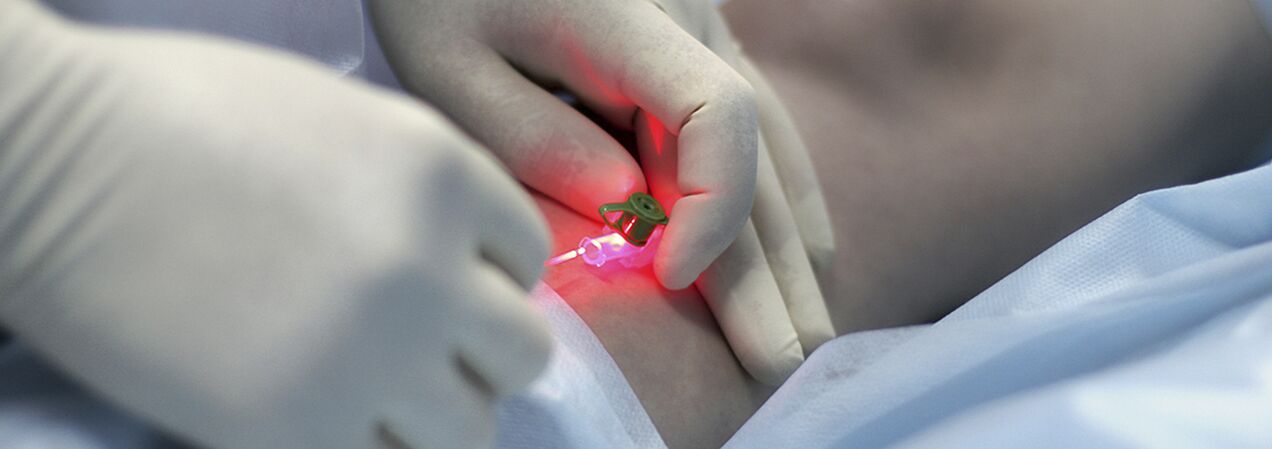
This is a method based on the principle of selective photocoagulation (photothermolysis), based on the different absorption of laser energy by different substances in the body.A feature of the method is the non-contact nature of this technology.The focusing head concentrates energy into a blood vessel in the skin.Hemoglobin in the vessel selectively absorbs laser beams of a certain wavelength.Under the action of the laser, destruction of the endothelium occurs in the lumen of the vessel, which leads to adhesion of the vessel walls.
The effectiveness of PLK directly depends on the depth of penetration of the laser radiation: the deeper the vessel, the longer the wavelength must be, which is why PLK has rather limited indications.For vessels with a diameter of more than 1.0-1.5 mm, microsclerotherapy is most effective.Given the wide and branched distribution of spider veins on the legs and the variable diameter of the vessels, a combined method of treatment is currently actively used: at the first stage, sclerotherapy is performed on veins with a diameter of more than 0.5 mm, then a laser is used to remove the remaining "stars" with a smaller diameter.
The procedure is practically painless and safe (skin cooling and anesthetics are not used), since the light of the device belongs to the visible part of the spectrum, and the wavelength of the light is designed so that the water in the tissues does not boil and the patient does not get burns.In patients with high sensitivity to pain, prior application of a cream with a local anesthetic effect is recommended.Erythema and swelling disappear in 1-2 days.After the course, for about two weeks, some patients may experience darkening or lightening of the treated area of the skin, which then disappears.In people with light skin, the changes are almost imperceptible, but in patients with dark skin or a strong tan, the risk of such temporary pigmentation is quite high.
The number of procedures depends on the complexity of the case - the blood vessels are at different depths, the lesions can be insignificant or occupy a fairly large surface of the skin, but usually no more than four sessions of laser therapy (5-10 minutes each) are needed.The maximum result in such a short time is achieved thanks to the unique "square" shape of the light pulse of the device;increases its effectiveness compared to other devices, while also reducing the possibility of side effects after the procedure.
Surgical treatment
Surgery is the only radical treatment method for patients with varicose veins of the lower extremities.The purpose of the operation is to eliminate the pathogenetic mechanisms (veno-venous reflux).This is accomplished by removing the main trunks of the great and small saphenous veins and ligation of the incompetent communicating veins.
Surgical treatment of varicose veins has a hundred-year history.Previously, and many surgeons still do, large incisions along the varicose veins and general or spinal anesthesia were used.The scars after such a "mini-phlebectomy" remain a reminder of the operation for life.The first operations on veins (according to Schade, according to Madelung) were so traumatic that the harm from them exceeded the harm from varicose veins.
In 1908, the American surgeon Babcock came up with a method of pulling out a saphenous vein using a hard metal probe with an olive.In an improved form, this method of surgery to remove varicose veins is still used in many public hospitals.Varicose veins are removed through separate incisions as suggested by surgeon Narath.Thus, the classic phlebectomy is called the Babcock-Narat method.Babcock-Narat phlebectomy has disadvantages - large scars after the operation and impaired skin sensitivity.Working capacity is reduced for 2-4 weeks, which makes it difficult for patients to agree to surgical treatment of varicose veins.
Phlebologists have developed a unique technology for the treatment of varicose veins in one day.Complex cases are operated with the help ofcombined technology.The main large varicose veins are removed by inversion stripping, which involves minimal intervention through mini-incisions (from 2 to 7 mm) in the skin that leave virtually no scars.The use of a minimally invasive technique involves minimal tissue trauma.The result of this operation is the removal of varicose veins with an excellent aesthetic result.Combined surgical treatment is performed under complete venous or spinal anesthesia, with a maximum hospitalization period of up to 1 day.
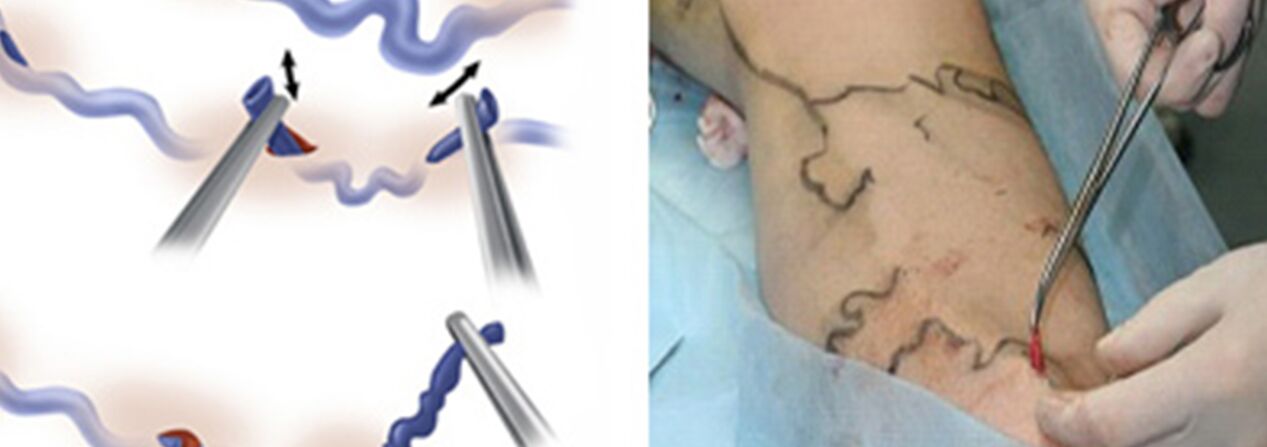
Surgical treatment includes:
- Crossectomy - crossing the place where the trunk of the great saphenous vein flows into the deep venous system;
- Stripping is the removal of a fragment of a dilated vein.Only the dilated vein is removed, not the whole one (as in the classic version).
In factminiphlebectomyreplaced the Narat technique for the removal of enlarged tributaries of the main veins.Previously, skin incisions of 1-2 to 5-6 cm are made along the course of the varices, through which the veins are isolated and removed.The desire to improve the cosmetic result of the intervention and to be able to remove veins not through traditional incisions, but through mini-incisions (punctures), forced doctors to develop tools that allow them to do almost the same through a minimal skin defect.Thus, sets of phlebectomy "hooks" of various sizes and configurations and special spatulas appeared.And instead of an ordinary scalpel, scalpels with a very narrow blade or needles with a rather large diameter began to be used to pierce the skin (for example, a needle used to take venous blood for analysis with a diameter of 18G).Ideally, the scar from a puncture with such a needle is practically invisible after a while.
Some forms of varicose veins are treated on an outpatient basis under local anesthesia.The minimal trauma during miniphlebectomy, as well as the low risk of intervention, allow this operation to be performed in a day hospital.After minimal observation in the clinic after the operation, the patient can be sent home on his own.In the postoperative period, an active lifestyle is maintained, active walking is encouraged.Temporary incapacity usually lasts no more than 7 days, after which it is possible to start work.
When is microphlebectomy used?
- When the diameter of the varicose trunks of the great or small saphenous vein is more than 10 mm;
- After spent thrombophlebitis of the main subcutaneous trunks;
- After trunk recanalization after other types of treatment (EVLT, sclerotherapy);
- Removal of very large individual varicose veins.
It can be a stand-alone operation or be part of a combined varicose vein treatment combined with laser vein treatment and sclerotherapy.The tactics of use are determined individually, always taking into account the results of the ultrasound duplex scan of the patient's venous system.Microphlebotomy is used to remove veins of different localization that have changed for various reasons, including on the face.Professor Varadi from Frankfurt developed his handy tools and formulated the basic postulates of modern microphlebectomy.Varadi's phlebectomy method provides excellent cosmetic results without pain or hospitalization.This is very painstaking, almost jeweler work.
After vein surgery
The postoperative period after the usual "classic" phlebectomy is quite painful.Sometimes large hematomas are a problem and swelling occurs.Wound healing depends on the phlebologist's surgical technique;sometimes there is leakage of lymph and long-term formation of noticeable scars;often after a major phlebectomy there remains a loss of sensation in the heel area.
Conversely, after a miniphlebectomy, the wounds do not require suturing, since these are only punctures, there is no pain, and in practice no damage to the skin nerves is observed.However, such phlebectomy results are achieved only by very experienced phlebologists.